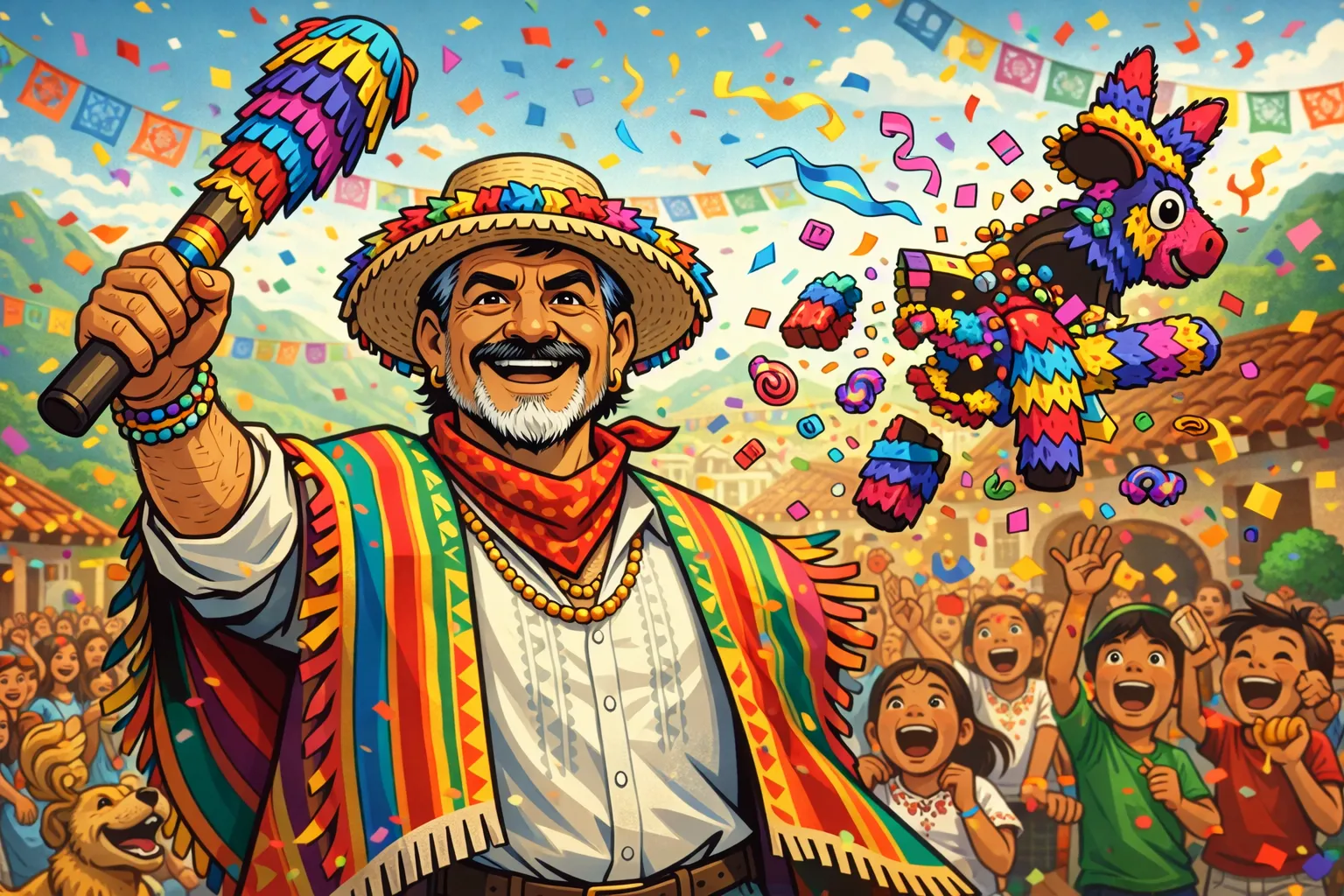
THE ONE THAT WOULDN'T BREAK
A Fanhattan Story — Casa de Boom #1
The piñata was ugly.
Papi had been building piñatas for thirty-one years; eleven thousand, give or take, though he'd stopped counting around number six thousand because the notebook got salsa on it. And he'd never built one this ugly. Lopsided. Lumpy. The tissue paper hung off it like wet laundry on a crooked line. One side bulged where it shouldn't and caved where it shouldn't and the whole thing looked like a donkey that had gotten into a bar fight with a birthday cake and lost.
He loved it immediately.
"Ay, fea," he whispered, smoothing the tissue with his thumb. "You are the ugliest thing Papi has ever made…You are perfect!"
It was 2:47 AM in Casa de Boom. Thunder shook the corrugated walls. Rain hammered Calle Rota hard enough to drown out the cumbia leaking from El Techo three blocks south. The shop smelled the way it always smelled: paste, sugar, sawdust, and the faint burnt-match stink that clung to everything in La Fiesta like a cologne nobody remembered putting on.
Papi hummed.
He always hummed when he built. Couldn't help it. The song came up from somewhere below his lungs. Not a song he chose, not a song he recognized, just a vibration that lived in his chest and climbed into his throat whenever his hands touched wet paper and wire frame. He'd tried to record it once. Played it back. Static. Just static, and underneath, something that sounded almost like breathing.
He'd thrown the recorder in the harbor.
Tonight the humming was louder than usual. Deeper. His fingers moved faster than he intended, folding and layering and stuffing with a rhythm that felt less like crafting and more like taking dictation. Like the piñata was telling him what it wanted to be.
That was new.
That was not great.
He stuffed the belly with the usual mix—candy, confetti, tissue scraps, three card shards he'd bought off Touchdown Terry at cost—and then his hands reached for something on the workbench he hadn't put there.
A river stone. Smooth. Gray. Warm to the touch, which was wrong because stones shouldn't be warm at 2:47 AM in an unheated workshop during a thunderstorm.
He held it up to the bare bulb hanging from the ceiling.
Something flickered inside the stone. Not light, exactly. More like the memory of light. The way a TV screen holds a ghost image after you turn it off.
Papi's mind's eye—the thing he never talked about, the thing he called "the tingle" when he was feeling poetic and "that thing where my teeth itch" when he wasn't—lit up like a switchboard.
Every piñata crafter worth a damn could feel probability fields. It was a prerequisite for the work, the same way a chef needed taste buds or a musician needed ears. You couldn't build a piñata that channeled belief energy if you couldn't feel belief energy. Basic stuff. Papi had explained this to exactly four people in his life, and three of them had looked at him like he was describing how to milk a cloud.
The fourth was Bailey Brownbag. She'd just nodded and started taking notes.
But this? The stone, the warmth, the flicker? This wasn't a probability field. This was something heavier. Denser. Like the difference between a puddle and a well.
He put the stone inside the piñata anyway.
His hands did it before his brain could object. Paper over stone. Paste. Seal. Done.
The humming stopped.
Papi stood there in the silence, paste drying on his fingers, staring at the ugliest piñata he'd ever built. His nose was bleeding. Thin trickle down his upper lip, copper taste on his tongue. He wiped it with his sleeve and barely noticed.
"What are you?" he asked the piñata.
It didn't answer.
Not yet.
He hung it the next morning from the big hook in the center of Casa de Boom—the primo spot, the one he usually reserved for the weekly showcase piñata, the one that caught the light from the open roll-up door and glowed like a lantern against the streamered walls.
The ugly piñata did not glow. It absorbed. Light hit it and sort of... stopped.
"Ohohoho," Papi said, because he always narrated his own reactions, partly for the customers and partly because silence made him nervous. "A rare one! Maybe ultra-rare! Look at this beast, amigos—she is special."
The morning crowd—six regulars, two lookie-loos from Meadow Hills who'd wandered in looking confused—stared at the piñata with the blank politeness of people waiting for someone else to go first.
Marco from the taquería across the street peered through the doorway. "That thing looks like a goat ate a rainbow and threw up."
"Exactly!" Papi clapped his hands. "Beautiful! Who wants first swing?"
Big Reina went first.
She always went first. Reina Espinoza, five-foot-ten, two-twenty, arms like anacondas, the undisputed smash champion of La Fiesta for eleven consecutive months. She paid her Scraps, picked up her bat—a Louisville Slugger she'd wrapped in duct tape and named La Justicia—and squared up.
Papi felt the probability field shift the way it always did when a session started. Belief energy flowed inward from the crowd, pooled around the piñata, thickened the air with potential. In his mind, in the part of his brain that processed the tingle, he could almost see it: golden threads pulling toward the center of the room, wrapping around the piñata like a cocoon.
Normal. Expected.
Usually, by this point, the piñata's internal threshold would register in his senses. Every piñata had one: a hidden breakpoint determined by its rarity, craftsmanship, and the density of belief energy embedded during construction. Papi had never been able to see actual numbers; this wasn't a video game, no matter what the kids on the message boards said. But he could feel ranges. Could tell the difference between a Common that would pop in six taps and an Epic that would survive forty.
He reached for this piñata's threshold the way he always did. Extended the tingle. Felt for the edges.
Nothing.
Not "very high." Not "off the charts." Nothing. Like reaching into a hole and finding no bottom.
His smile didn't waver—thirty-one years of showmanship had made that smile load-bearing—but his stomach clenched.
Reina swung.
The bat connected dead center. Perfect form. Enough force to shatter a cinder block.
The piñata didn't move.
Not "barely moved." Not "absorbed the impact." Didn't. Move. La Justicia bounced off the tissue paper like it had hit a wall of concrete wrapped in crepe, and Reina stumbled backward two steps, her wrists singing from the impact.
"¿Qué demonios...?"
Papi clapped twice. Big. Loud. Showman. "Ooooh! A stubborn one! Hit it again, Reina! Show it who's boss!"
She hit it again. Four more times. Then eight more. Then she was breathing hard and sweating and La Justicia had a dent in it that hadn't been there before, and the piñata hung from its hook, motionless, undamaged, slowly rotating in a room where there was no breeze.
No cracks.
No swelling.
No confetti leaking from the seams.
Nothing.
"It's defective," Reina said.
"Impossible," Papi said. "Papi does not make defective piñatas. Papi makes piñatas that are not yet ready to surrender." He turned to the crowd. His voice found its groove; the pitch and rhythm of a man who'd spent three decades turning confusion into excitement. "This one has spirit, amigos! This one fights back! Who else wants to try? No charge! Papi's treat! Step right up!"
They stepped right up.
Four more smashers that morning. Two in the afternoon. A guy named Dutch Junior from Vol Valley who bench-pressed four hundred pounds and could barely open the door without ducking, who was brought in specifically by Reina, who was now treating the piñata like a personal insult. He hit it with everything he had.
The piñata didn't care.
By closing time, eleven people had taken a shot. Bats. Hammers. A kid with a running start and a cast-iron skillet.
Nothing.
Zero damage.
Papi locked the shop at 9 PM, flipped the sign, and stood alone in the middle of Casa de Boom staring at his creation.
"Okay, fea," he said quietly. "What's the game?"
The game, as it turned out, was patience.
By day three, word had spread beyond La Fiesta. A busker from The Bayou showed up with a sledgehammer, took twelve swings, and left without speaking. Two scouts from The Proving Grounds watched from the sidewalk, muttered into phones, and disappeared. A food blogger from Meadow Hills recorded the whole thing for her channel and got four hundred thousand views in six hours.
The unbreakable piñata was becoming a thing.
Papi leaned into it because leaning into things was what Papi did. He draped the shop in extra streamers. Cranked the music. Offered free churros to anyone willing to swing. "Step right up! The piñata that cannot be broken! Show it your strength, amigo! Or maybe—" dramatic pause, finger raised, eyebrows up "—it shows you yours."
He was, outwardly, having the time of his life.
Inwardly, the tingle hadn't stopped since he'd hung the thing up. It pulsed behind his molars like a second heartbeat. He'd wake at 3 AM tasting copper and ozone. The probability field around Casa de Boom, always active, always a little chaotic, that was La Fiesta's nature, had thickened into something heavy and still, like the air before a Gulf Coast hurricane.
On day four, someone from The Swamp, dressed appropriately in a dirty sleeveless white undershirt and jean shorts, showed up with a chainsaw.
"No," Papi said.
"It's a piñata."
"It's my piñata, and you will not bring a chainsaw into my house."
The guy revved the engine. Papi didn't flinch. Stared at him with flat brown eyes until the chainsaw guy looked away, muttered something about wasting his afternoon, and left.
Serious Papi. The regulars noticed. Whispered about it over tacos at Marco's.
On day four, something else arrived.
A man. Lean. Quiet. Dark suit that didn't belong on Calle Rota the way a tuxedo doesn't belong at a taco stand. He walked into Casa de Boom during the afternoon rush, stood in the back corner, and watched. Didn't talk to anyone. Didn't try to swing. Just watched the piñata with the patient concentration of someone cataloging livestock.
Snake tattoo on his left forearm. Barely visible under the cuff. Papi saw it when the man reached up to scratch his jaw.
Syndicate.
Papi's showman smile held. His hands, hidden behind the counter, went still.
The operative stayed twenty minutes. Took no notes, or at least none Papi could see. Bought a bag of Mexican candy from the counter on his way out, paid exact change, and left.
He said nothing.
That was worse than threats.
By day five, it started humming.
Not loud. Not at first. A vibration more felt than heard, a subsonic throb that made the fillings in Papi's back teeth ache and the hanging piñatas along the walls sway gently on their hooks, pendulums keeping time with something underground.
The customers couldn't hear it. Not yet. But the dogs on Calle Rota could. They howled at night now. Long, sustained, mournful. The cats had disappeared entirely.
Papi started closing early. Locking the piñata in the back room. Sitting on the stoop of Casa de Boom after sunset, drinking café con leche and watching La Fiesta's string lights sway, trying to convince himself he was overreacting.
He wasn't overreacting.
On day six, Bailey Brownbag called.
"The probability readings from your district are spiking," she said without preamble. Bailey didn't do small talk. Papi appreciated this about her, even if it meant conversations with the woman felt like being debriefed by a friendly IRS agent. "I've been monitoring La Fiesta's baseline for two years. You're running forty-three percent above normal and climbing."
"Forty-three percent." Papi rolled the number around in his mouth. It tasted like the stone had felt. Heavy. Warm. Wrong.
"What changed?"
"I built a piñata."
Silence on the line. Then: "I need to study it."
"She's not ready."
"Papi, a forty-three percent deviation in ambient probability is not—"
"I said she's not ready."
"Ready for what?"
He didn't have an answer for that. The question rattled around inside him like a marble in a tin can, bouncing off everything it touched and settling nowhere. Ready for what? He didn't know. He just knew the ugly piñata in his back room wasn't finished becoming whatever it was becoming, and rushing that process felt dangerous the same way opening a pressure cooker early felt dangerous.
You wait. You let it build. And when it's ready, you stand back.
"I'll call you," Papi said, and hung up before Bailey could argue.
Day seven.
Papi entered Casa de Boom at 11:14 PM, alone, through the back door. He'd told himself he was checking inventory. He'd told himself he wanted to reorganize the seasonal display. He'd told himself six different lies between his apartment and the shop, and his feet had carried him to the back room door anyway because his feet, apparently, were done listening to his brain.
He opened the door.
The piñata was glowing.
Soft. Pulsing. Warm gold, like sunset trapped in tissue paper. Light leaked through cracks that hadn't existed an hour ago—he'd checked, because he checked every hour now, because sleep was a thing that happened to other people this week—and the cracks formed patterns. Lines. Curves.
Not random.
Language.
The humming was loud enough to hear with human ears now. A low, resonant tone that made Papi's ribs vibrate and his vision blur at the edges. The probability field in the room was so dense he could see it—golden threads hanging in the air like cobwebs, drifting, pulsing with the same rhythm as the glow.
In thirty-one years, Papi had never seen a raw probability field with his naked eyes.
He should have left. Should have called Bailey. Called Billy. Called anyone.
He stepped closer.
The glow intensified. The cracks widened. Something inside the piñata shifted—not falling, not settling—moving. Deliberately. Like a bird adjusting on a perch.
Papi reached out. His hand was shaking. The paste stains on his fingers looked black in the golden light.
He touched the piñata.
Warm. Alive-warm. Pulse-warm. The tissue paper felt like skin over a sleeping animal's ribs; that same gentle rise and fall, that same sense of contained breathing.
"What are you?" he whispered.
The humming stopped.
The silence was worse.
Then, from inside the piñata, from inside the ugly, lopsided, lumpy piñata he'd built in a thunderstorm because his hands told him to, a voice spoke.
Not a voice. A vibration shaped like a voice. Sound that bypassed his ears and arrived directly in the center of his skull, warm and enormous and ancient.
It said: Alejandro.
Papi's blood went cold.
Nobody called him Alejandro. Not his mother, dead twelve years. Not his ex-wife, gone twenty. Not a single soul in La Fiesta, where he'd been "Papi" so long the name had eaten his identity whole. Alejandro was a ghost. A name on a birth certificate in a filing cabinet in a government building in a city he hadn't visited in four decades.
The piñata knew it anyway.
He stumbled backward. Knocked a table. Supplies crashed. Tissue paper, spools of wire, a bag of Jolly Ranchers that exploded across the concrete floor like shrapnel. He hit the door frame with his shoulder, spun, half-ran half-fell through the shop. Past the showcase hooks. Past the streamers. Past thirty-one years of paper and paste and laughter. Out the front door and onto Calle Rota, where he fumbled the padlock three times before his hands stopped shaking enough to close it.
He stood on the street. Breathing hard. The string lights swayed above him in a breeze that didn't exist. La Calle de los Muertos glowed at the far end of the block, its candles steady despite the wind, because there was no wind, because La Fiesta's probability field was so warped that the laws of physics were taking suggestions.
"¿Qué pasó, Papi?"
A kid. Maybe twelve. Sitting on the curb across the street with a popsicle, watching him with the unimpressed calm of someone who'd grown up on Calle Rota and had seen stranger things than a sixty-three-year-old man falling out of his own shop at midnight.
"Nothing," Papi said. "Go home. It's late."
"You look scared."
"Papi is never scared." The words came out on autopilot. The showman's mask, snapping into place over the terrified face underneath. Thirty-one years of practice. Smile load-bearing.
The kid licked his popsicle. Cherry. Stained his lips the color of old blood.
"What did the piñata do?"
Papi looked at the kid for a long moment. The words climbed up from the same place the humming lived and escaped before he could catch them, and once they were in the air, he couldn't take them back.
"It said my name."
The kid's popsicle stopped halfway to his mouth.
"Your real name?"
Papi stared at him. "How do you know it's not—"
"Nobody's named 'Papi,' man. That's like being named 'Dude.'"
Fair point.
Behind him, through the locked door of Casa de Boom, through the closed back room, through the tissue paper and wire and paste and the warm gray stone he should never have picked up—
The humming started again.
Louder.
The padlocked door vibrated in its frame.
The kid looked past Papi at the shaking door. His popsicle dripped cherry onto the curb.
"Yeah," the kid said quietly. "I'd be scared too."
Papi turned back to the shop. The golden light was visible now through the gaps in the roll-up door. Thin lines of warm luminescence painting the sidewalk in patterns that, if you squinted, if you tilted your head, looked almost like the cracks on the piñata's surface.
Almost like language.
He pulled out his phone. Dialed. It rang twice.
"Bailey. It's Papi." His voice was flat. Calm. Serious Papi, and even he could hear how wrong it sounded coming out of his own mouth. "I need you at Casa de Boom. Bring your equipment. Bring Billy."
Pause.
"Papi, it's midnight—"
"Bring them both, mi vida. Bring whoever you trust." He watched the golden lines on the sidewalk pulse and shift and rearrange themselves into shapes he almost recognized. "Because something woke up inside my piñata, and I think it's been waiting a very long time to talk."
He hung up.
The humming grew.
And on Calle Rota, in the heart of La Fiesta, the string lights swayed in a wind that came from nowhere and everywhere and maybe—just maybe—from inside a lopsided, lumpy, ugly piñata that was done being patient.
To be continued...