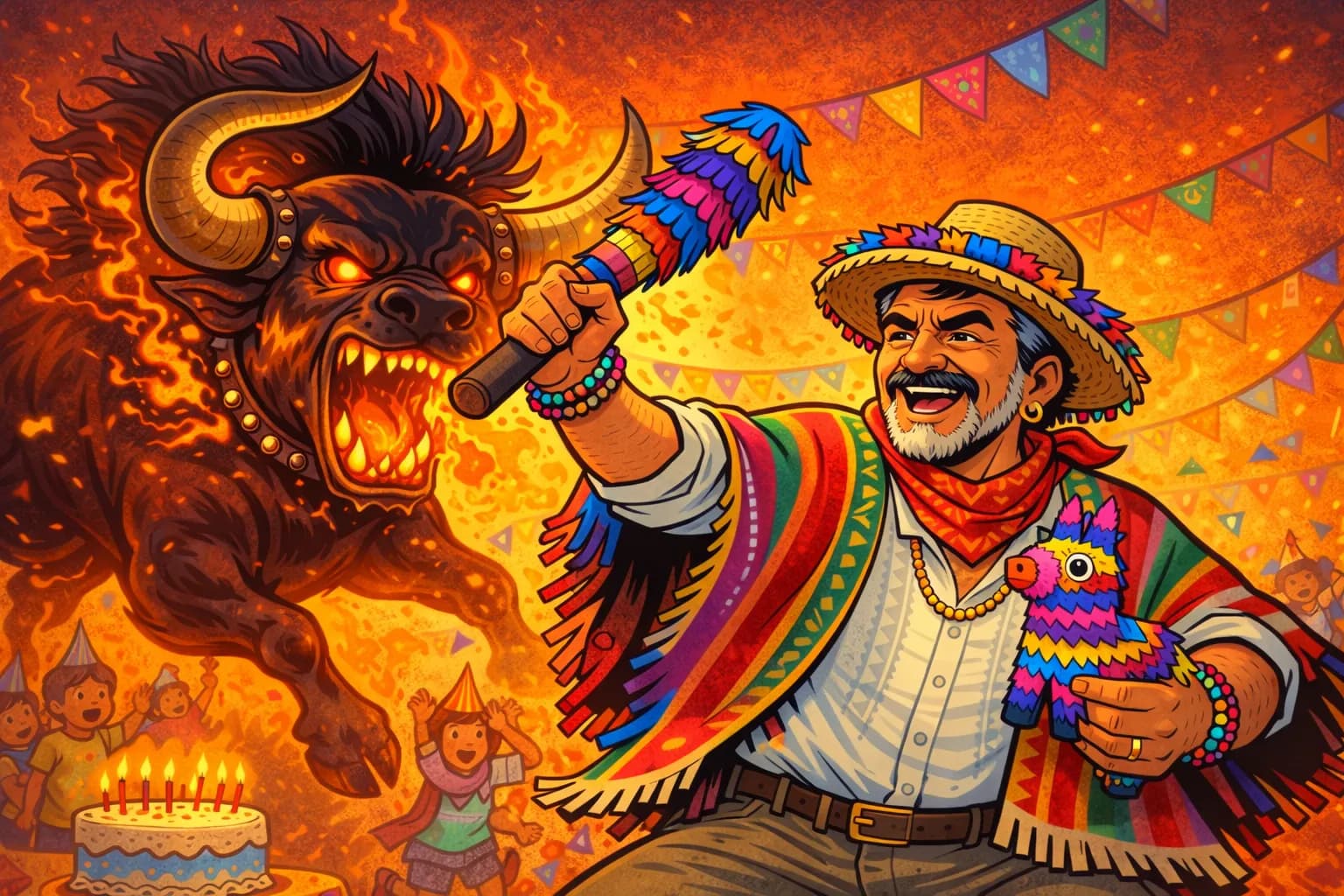
BOOM DEBT
A Fanhattan Story — Casa de Boom #2
The girl walked into Casa de Boom fourteen minutes before closing on a Tuesday, and Papi knew she was trouble the way you know rain is coming; not because you see clouds, but because your knees ache.
She was maybe twenty-two. Thin. Dark hair pulled back so tight it stretched the skin at her temples. Faded army jacket two sizes too big, sleeves rolled to the elbows, hands stuffed in the pockets like she was holding herself together from the inside. She moved through the shop without looking at the piñatas, without looking at the streamers or the papel picado or the wall of seasonal displays Papi had spent three hours arranging that morning. She walked straight to the counter like she'd rehearsed the route.
Her left eye was bruised. Yellow-green, about a week old. Healing but ugly. She'd tried to cover it with makeup. Hadn't quite managed.
"I need a private session," she said.
Her voice was steady. The rest of her wasn't. Her right hand, the one she'd pulled from her jacket pocket to lay a stack of Scraps on the counter, trembled like a plucked guitar string.
"Of course, amiga! Papi's got a beautiful—"
"The most expensive piñata you have. Doors locked. No one watching."
Papi's smile held. Load-bearing, as always. But behind it, something cold turned over in his gut.
He dealt with all kinds in Casa de Boom. Tourists. Regulars. Kids blowing birthday Scraps. Drunk guys from The Swamp trying to prove something. He could read a customer the way a bartender reads a drunk: body language, eye contact, the particular quality of their desperation. Twenty years behind a counter teaches you things a psychology degree can't.
This girl wasn't here for fun.
"What's your name, mi vida?"
"Lucia." She didn't offer a last name. "How much for the top shelf?"
Papi glanced at the stack of Scraps. Counted without touching them. Ten thousand. Every bill creased and smoothed and stacked with the anxious precision of someone who'd counted the money forty times on the walk over.
Ten thousand was a lot. More than most people spent in a month at Casa de Boom. Enough for three Mythic-tier sessions with buybacks.
"That's a lot of Scraps for a Tuesday night."
"Is it enough?"
"For what?"
Lucia's jaw tightened. The bruised eye twitched. "For whatever's in the most expensive piñata you've got."
Papi studied her. The army jacket. The tight hair. The flinch when he'd reached above her head for a display piñata—subtle, quick, buried under layers of practiced composure, but Papi had been watching people for three decades and he caught it.
Someone had taught this girl to duck.
"Lucia," he said. His voice dropped half a register. Not Showman Papi. Not Serious Papi either. Something in between: the voice he used with stray dogs and lost children and people standing on the edge of decisions they couldn't take back. "You can tell Papi what's going on. Whatever it is. This shop has heard everything."
"I need what's inside," she said.
That was all she'd give him.
He took the Scraps.
Casa de Boom had three employees besides Papi.
Tomás worked the stockroom. Twenty-six. Grew up two blocks from Calle Rota. Quiet kid, strong back, knew where every piñata was shelved by rarity and season without checking the logs. He'd been with Papi four years.
Yolanda handled the register and the front-of-house during peak hours. Forty-one. Moved to La Fiesta from The Bayou after a bad divorce. Talked too much, laughed too loud, and could calculate change in her head faster than the register could print it. Three years.
Danny was the newest. Nineteen. Swept floors, restocked supplies, ran errands. Showed up six months ago looking for work. Said he was from Cabot's Landing. Didn't talk about family. Papi had hired him because the kid had good hands and because Papi had a weakness for strays.
He sent all three home before Lucia's session. Locked the front door. Pulled the roll-up gate halfway down. Flipped the sign.
The shop felt different empty. Bigger. The streamers hung still. The piñatas along the walls threw long shadows in the overhead light, shapes that looked almost like a crowd of witnesses choosing not to watch.
Papi pulled a piñata from the top shelf. Mythic-tier. He'd built it last week; heavy, dense, beautiful. Crimson and gold tissue paper, intricate folds, stuffed with premium loot: card shards, cosmetic fragments, a handful of rare gear tokens, and enough candy to fill a pillowcase.
He hung it on the center hook.
The probability field shifted. Belief energy pooled inward the way it always did…but something felt off. The texture of it. Usually a Mythic session had a warm density, like honey. This felt granular. Rough. Like sand in the current.
Papi filed it away and handed Lucia the bat.
"Whenever you're ready, amiga."
Lucia squared up. No hesitation. She swung; hard, efficient, no wasted motion. The bat connected.
The piñata cracked.
First swing. Hairline fractures spiderwebbed across the surface. Confetti dust puffed from the seams.
Papi blinked.
A Mythic piñata cracking on the first swing was wrong. Not unusual-wrong. Mechanically wrong. He'd built this one himself. He knew its threshold: felt it during construction, embedded it with his own belief energy, sealed it with the humming. It should have taken thirty hits minimum. Forty if the smasher was average. This was a piñata that was built to endure.
Lucia swung again.
The piñata split. Stage two cracks, swelling, candy dust in the air…all in two hits. The probability field surged, hot and sharp, and Papi's tingle screamed at him like a smoke alarm.
Something was very wrong.
Third swing.
The piñata detonated.
Not broke. Not burst. Detonated. The explosion was bigger than it should have been; confetti and candy and tissue fragments blasting outward in a sphere, screen-shake without a screen, a concussion of joy and sugar that rattled the windows and knocked two piñatas off the wall.
Lucia didn't flinch. Didn't celebrate. Didn't even look at the loot raining down around her feet, or the card shards, the cosmetic tokens, the gear fragments scattering across the concrete floor like precious confetti.
She was looking at one thing.
A brass key. Small. Old. Tarnished green at the edges. It sat in the middle of the debris field on a scrap of crimson tissue paper, gleaming dully under the shop lights.
A key Papi had not put inside the piñata.
Lucia lunged for it. Snatched it off the floor. Shoved it deep into her jacket pocket with a hand that had stopped trembling, replaced by something harder: purpose.
"Thank you," she said. Already moving toward the door. Already gone behind the eyes, checked out, mission complete, the transaction finished in every way that mattered to her.
"Lucia, wait—"
She didn't wait. She pulled up the roll-up gate, ducked under it, and disappeared into Calle Rota's Tuesday night crowd without looking back.
Papi stood in the wreckage. Confetti settling in his hair. Candy crunching under his shoes. The probability field dissipating like steam, leaving behind that gritty, sandy residue that didn't feel right and hadn't felt right since he'd pulled the piñata off the shelf.
He looked at the debris.
Crouched. Picked up a fragment of the piñata's shell, a fist-sized piece of crimson tissue over wire frame, the kind of piece he'd built ten thousand times, the kind of piece he could identify by touch with his eyes closed.
Except.
On the inside of the tissue paper, pressed into the paste so faintly you'd miss it if you weren't looking, were symbols.
Small. Precise. Drawn in something that looked like graphite but smelled like iron. Three symbols arranged in a triangle: a circle with a line through it. A square with a dot in the center. And something that looked like a snake eating its own tail.
Papi had not put those there.
His hands went cold.
He checked every piñata in the shop.
It took two hours. He pulled each one down, held it to the light, felt for the tingle, examined the interior seams where the tissue layers overlapped. Most were clean. His work. His paste. His energy signature, familiar as his own heartbeat.
Three were not.
Three piñatas, all high-tier, all built within the last month, all shelved in the premium section, had been opened, modified, and resealed so carefully that the external appearance was flawless. Only the inside told the truth: the same three symbols, pressed into the paste. And inside each, nestled among the candy and shards and standard loot, something extra.
Piñata one: a brass key identical to Lucia's.
Piñata two: a small glass vial containing a liquid that caught the light like mercury but weighed almost nothing.
Piñata three: a folded piece of paper, sealed with wax, bearing no markings on the outside.
Papi didn't open the paper. Didn't uncork the vial. Didn't touch the second key. He set them on his workbench and stared at them the way a man stares at a snake on his kitchen floor: very still, very focused, calculating the distance to the nearest weapon.
Someone had gotten into Casa de Boom. Gotten past the locks. Gotten past Papi's own probability wards, the subtle energy signatures he wove into the shop's walls and door frames that buzzed when unfamiliar hands touched his inventory.
Someone had opened three of his piñatas, inserted items and symbols, and resealed them without tripping a single alarm.
Which meant someone who understood his work. Someone who knew how the wards functioned. Someone with access and skill and enough familiarity with Papi's crafting style to replicate his seals.
Someone inside.
Tomás. Yolanda. Danny.
Papi sat down on his workbench stool. The shop was silent except for the distant thump of music from El Techo and the ever-present hum from the back room; the ugly piñata, still glowing, still waiting, still doing whatever it was doing behind a locked door Papi hadn't opened in a week.
He picked up his phone. Dialed a number from memory.
Two rings. A gravel voice with bar noise behind it.
"Shep's."
"Shepherd, it's Papi."
Pause. In all the years they'd known each other, Tuesday drinks at the border between La Fiesta and Stadium South, trading gossip and complaints about the city council, Papi had never called the bar line. They communicated through in-person visits. Through nods across crowded rooms. Through the unspoken language of two men who ran establishments in neighborhoods where running an establishment meant knowing things you wished you didn't.
"What happened?" Shep asked. No preamble. The man could read a phone call the way Papi could read a customer. And Papi was maybe the only person who could call him "Shepherd" without getting a fist through his teeth.
"Someone is using my piñatas as dead drops. Items planted inside. Symbols I don't recognize. Three that I've found, maybe more I haven't. They got past my wards."
Silence.
"I need to talk to Billy," Papi said.
Longer silence. Shep's silences were famous. They lasted exactly as long as they needed to and communicated more than most people's paragraphs.
"I'll make a call," Shep said. "Don't touch anything else. Don't confront anyone."
"I know how this works, Shepherd."
"I know you do. That's why I'm telling you anyway." Click.
Papi set the phone down. Stared at the three items on his workbench: the key, the vial, the sealed paper. Three objects that had no business being inside his piñatas, placed there by someone he trusted, for a purpose he couldn't see.
He thought about Lucia. The bruise. The trembling hand. The way she'd grabbed the key like it was oxygen.
Somebody had told her the key would be there. Somebody who knew which piñata to send her to. Which meant the dead drops weren't random. They were deliveries. And Casa de Boom wasn't just being used as a hiding spot.
It was being used as a distribution network.
His piñatas. His shop. His name.
Papi's jaw tightened. The showman's smile was nowhere near his face. Serious Papi, sitting alone in his own shop at midnight, staring at the evidence that someone had turned his life's work into a Syndicate supply chain.
He didn't sleep.
He sat in the shop until 3 AM, then walked to his apartment, lay on his bed, and stared at the ceiling fan rotating in the dark. His mind did the same thing, rotating, circling, coming back to the same three names.
Tomás. Four years. Reliable. Quiet. Knew the shop better than anyone except Papi. Had access to every shelf, every stockroom, every ward signature. Could reseal a piñata in his sleep.
Yolanda. Three years. Loud. Trustworthy. Handled cash flow, knew the customer patterns, could tell you which piñata sold on which day. But she'd never built one. Didn't have the tingle. Couldn't replicate Papi's seals.
Danny. Six months. The newest. The unknown. Good hands. From Cabot's Landing, where the docks met the Syndicate's shipping operations. Where a nineteen-year-old kid with no family and no history could pick up useful skills from the wrong people.
Papi didn't want it to be Danny. He liked Danny. The kid showed up early, worked hard, didn't complain. Had that hungry quiet that reminded Papi of himself at nineteen. Before Casa de Boom, before the tingle meant anything, before he understood what the piñatas could do.
But wanting didn't make it true. And liking someone had never stopped them from lying.
The next night, 9:15 PM, two men walked into Casa de Boom.
Papi had reopened for the day. Normal hours. Normal crowd. Showman smile, big voice, churros on the counter. He'd told himself to act natural, and after thirty-one years, acting natural was the easiest lie he knew.
The two men were not natural.
They entered side by side, moving in sync. Clean suits; not expensive, not cheap, the precise middle ground that said professional without specifying the profession. One was tall, bald, built like a retired middleweight. The other was shorter, softer, with reading glasses and the mild expression of an accountant who'd seen things that accountants shouldn't see.
They were not the snake-tattoo operative from the week before. These were different. Higher up. The kind of Syndicate that didn't need to flash tattoos because their authority was structural, not performative.
They browsed.
Papi watched from behind the counter, rearranging a display of seasonal candy he'd already arranged twice. His tingle was screaming, not because of probability fields, but because every instinct he'd built in thirty-one years of operating on Calle Rota was telling him to pay attention.
The tall one picked up a piñata from the mid-tier shelf. Examined it. Set it down. Picked up another. Held it to the light the way a jeweler holds a stone, looking for something specific.
The short one approached the counter.
"Evening," he said. Pleasant. Conversational. "My friend and I have been hearing about this place. The unbreakable piñata, the legendary boom. Quite the reputation you've built."
"Papi builds piñatas and reputations, amigo. Both are made with love." The showman's voice, running on autopilot while his brain ran calculations underneath.
"We'd like to purchase one. To go."
"Of course! What rarity? Papi has Common, Uncommon, Rare, Epic—"
"That one." The short man pointed at the piñata his partner was holding. High-tier. One of the three tampered piñatas Papi had not removed from the shelf, because Shep had said don't touch anything, and because leaving them in place might tell him more than pulling them down.
One of the three marked with symbols.
They knew which one.
"Excellent choice!" Papi said. His voice didn't crack. His smile didn't waver. Thirty-one years. "An Epic beauty. She'll give you a wonderful boom."
They paid. The tall one tucked the piñata under his arm, gently, carefully, the way you carry something valuable. Not the way you carry something you plan to smash.
They walked toward the door. Papi's hands gripped the counter edge hard enough to whiten his knuckles.
The short one stopped. Turned back. Adjusted his reading glasses.
"We appreciate your cooperation, Papi."
The words landed like a slap.
Papi hadn't cooperated. Hadn't agreed to anything. Hadn't spoken to anyone about the dead drops except Shep, thirty minutes ago.
We appreciate your cooperation.
The sentence was a frame. A pre-built alibi. If anyone asked—if Billy asked, if the Resistance investigated—the Syndicate could point at Casa de Boom and say: He was in on it. He cooperated.
The short man smiled. Mild. Professional. The accountant who'd seen things.
They left.
The door closed.
The shop was quiet.
Papi stood behind his counter in the middle of his life's work, surrounded by piñatas he'd built with his own hands, in a shop he'd opened thirty-one years ago because he believed that celebration was a kind of power and joy was a kind of weapon and the boom was the most honest thing in Fanhattan.
And someone inside—Tomás, Yolanda, or Danny—had sold all of it to the Syndicate for a price Papi would never know.
He looked at the two remaining tampered piñatas on the shelf. The key. The vial. The sealed letter.
He thought about Lucia's bruise. The trembling hand.
He thought about what "cooperation" meant when you hadn't agreed to cooperate.
He picked up his phone.
"Shep. They were here. Two of them. They bought one of the marked piñatas and walked out."
"Did they—"
"They thanked me for my cooperation." Papi's voice was flat. Dead. A version of Serious Papi that even Shep hadn't heard before. "They're building a story, Shepherd. They're making it look like I'm working with them. And someone in my shop, someone I trust, is helping them do it."
Silence on the line. Long. Heavy.
"Billy can meet you tomorrow night," Shep said. "Neutral ground. My place."
"Tomorrow night."
"Don't do anything stupid before then."
Papi looked around Casa de Boom. The streamers. The papel picado. The string lights reflecting off thirty-one years of paste and paper and laughter. The center hook where piñatas had hung and swelled and cracked and burst open to shower joy on everyone who swung.
"Define stupid," Papi said.
He hung up.
In the back room, the ugly piñata hummed.
And Papi sat alone in his shop, the showman's mask off for the night, and began making a list.
Three names.
One of them was a traitor.
And tomorrow, he'd have to look all three in the eye and smile like nothing was wrong, because Piñata Papi's smile was load-bearing, and the moment it cracked, everything he'd built would come down harder than any piñata ever had.
To be continued...